Sometimes it's difficult to comprehend the enormous impact earning a few extra percentage points has on your portfolio each year. Paul Merriman in his article A Vanguard fund strategy to double your nest egg does a pretty good job putting it in perspective. Not only does he give you a great idea for a balanced, well-diversified (and cheap) portfolio, but he highlights how you can double your money once you retire.
Merriman explains how a simple portfolio made of Vanguard index funds has outpaced the S&P 500 by 2.2% over the past 10 years. Does that 2.2% difference make a big impact over the life of your portfolio? Merriman explains that "on a $100,000 portfolio over 10 years, that extra performance is worth $45,901 ($250,095 at 9.6% vs. $204,194 at 7.4%)....A typical investor will have money in the market for at least 40 years, including pre-retirement and postretirement periods. Over that long span, a $100,000 portfolio would grow to $3.91 million at 9.6% vs. only $1.74 million at 7.4%...This seemingly small difference in return is equally significant to younger investors accumulating assets. If you started with $5,000 and added that same amount every year for 40 working years, a return of 7.4% would give you a portfolio worth $1.19 million. If instead you earned 9.6%, you would wind up with $2.18 million — nearly twice as much.."
However, there is a catch according to Merriman, and this extra return isn't entirely free. When starting out, it may take a few hours to set up your portfolio and then maybe an hour to rebalance investments each year. If you invest for 40 years, maybe you spend 50 total hours working on your portfolio. If your reward for your efforts is $990,000 (the difference between a 7.4% return and 9.6% return - see above), that gives you $19,800 per hour of work. Hey, I think I'll take that.
Sunday, November 24, 2013

Wednesday, October 2, 2013
How Long-Term Investors Are Failing
I came across a great article today by Paul Merriman titled "7 Reasons Why Retirement Savers Fail." He explains how investors continue to work against themselves when investing and why they regularly achieve returns much lower than popular indices. The entire article is well worth a read but here are a few clips:
"In the 20 years ending Dec. 31, 2012, the Standard & Poor’s 500 Index compounded at 8.2% while the average investor in U.S. equity funds made only 4.3%. In other words, nearly half the return of the market was lost....How did investors lose half the return of the market? Where did it go? Three powerful forces took it away. First, investor behavior, mostly emotion-based buying and selling based on emotions, costs two percentage points. That brings the return down to 6.2%.Second, there's the cost of running funds that are trying to beat the market. The average annual cost of operating a fund, 1.3%, reduces the return further, to 4.9%. Third, portfolio turnover is almost always higher in actively managed mutual funds — sometimes much higher. This can take away another 0.6 percentage points, bringing the return down to the 4.3% reported by Dalbar."
"The latest report repeats a conclusion Dalbar has reached year after year: 'No matter what the state of the mutual fund industry, boom or bust: Investment results are more dependent on investor behavior than on fund performance. Mutual fund investors who hold on to their investments are more successful than those who time the market.' The answer, it seems obvious, is for investors to stay in the game. They will do that only if they have confidence in the choices they have made. I think the most dependable way to achieve the full returns of the market is to invest in a diversified mix of index funds with low expenses. If you couple this with patience and with enough bond funds to keep you within your comfort level, then I think you are likely to be more successful than 99% of all other investors."
Paul Merriman writes a lot of good stuff and I recommend anything he writes. If anyone is interested in reading more, check out his website. He has some free investing books that you can download!
"In the 20 years ending Dec. 31, 2012, the Standard & Poor’s 500 Index compounded at 8.2% while the average investor in U.S. equity funds made only 4.3%. In other words, nearly half the return of the market was lost....How did investors lose half the return of the market? Where did it go? Three powerful forces took it away. First, investor behavior, mostly emotion-based buying and selling based on emotions, costs two percentage points. That brings the return down to 6.2%.Second, there's the cost of running funds that are trying to beat the market. The average annual cost of operating a fund, 1.3%, reduces the return further, to 4.9%. Third, portfolio turnover is almost always higher in actively managed mutual funds — sometimes much higher. This can take away another 0.6 percentage points, bringing the return down to the 4.3% reported by Dalbar."
"The latest report repeats a conclusion Dalbar has reached year after year: 'No matter what the state of the mutual fund industry, boom or bust: Investment results are more dependent on investor behavior than on fund performance. Mutual fund investors who hold on to their investments are more successful than those who time the market.' The answer, it seems obvious, is for investors to stay in the game. They will do that only if they have confidence in the choices they have made. I think the most dependable way to achieve the full returns of the market is to invest in a diversified mix of index funds with low expenses. If you couple this with patience and with enough bond funds to keep you within your comfort level, then I think you are likely to be more successful than 99% of all other investors."
Paul Merriman writes a lot of good stuff and I recommend anything he writes. If anyone is interested in reading more, check out his website. He has some free investing books that you can download!
Sunday, September 8, 2013
Your Best Investment Move Ever
I think one of the huge problems investors face these days is knowing what information to trust and what information should be ignored. Do we trust prestigious newspapers like the Wall Street Journal or the New York Times? How about the Wall Street banks? They presumably have the most resources and, hence, the best information right? How about a friend or family member who insists he knows the next hot investment? Paul Merriman wrote a great article about just this topic called "Your Best Investment Move Ever." Unfortunately, the "right" investment source is probably one that is hardly ever in the news. That in itself is a mistake. Check out the article though. It's a quick read and has tons of good information in it. A few quick pieces from the article:
"Every investor can choose among three basic sources: Wall Street, the huge industry that's perpetually hungry for profits; friends, neighbors, relatives and others who are eager to show how smart they are; and the academic community, which rigorously studies what works — and what doesn't.
I call this choice Wall Street vs. Main Street vs. University Street. My pick is University Street and I've never regretted it."
And then a little bit later...
"You see, it was the academic community that taught me decades ago to add asset classes with long-term performance records higher than the S&P 500 Index, without additional risk.
All I did was apply the lessons. Perhaps the greatest of these was that proper asset allocation accounts for the overwhelming majority of the results of a portfolio."
I always made a point to largely ignore most of what i hear on TV or read in newspapers about investing. Most of the information I use comes from books written by trusted scholars. Below are a list of books I would recommend reading:
The Little Book of Common Sense Investing: The Only Way to Guarantee Your Fair Share of Stock Market Return by John Bogle (side note: I recommend anything that John Bogle writes)
A Random Walk Down Wall Street: The Time-Tested Strategy for Successful Investing by Burton Malkiel
The Elements of Investing: Easy Lessons for Every Investor by Burton Malkiel and Charles Ellis
The Power of Passive Investing: More Wealth with Less Work by Richard Ferri
And if you are feeling ambitious...
John Bogle on Investing: The First 50 Years by John Bogle
Enjoy!
(Paul Merriman's bio on Marketwatch reads: "Paul Merriman is committed to educating people of all ages to get the most from their retirement investments. Founder of Merriman Wealth Management, a Seattle-based investment advisory firm, he is the author of numerous books on investing: "Financial Fitness Forever," "Live It Up Without Outliving Your Money," and the new "How To Invest" series, free at his website: "How To Invest" series: "First Time Investor," "Get Smart or Get Screwed: How to Select the Best and Get the Most from Your Financial Advisor" and "101 Investment Decisions Guaranteed to Change Your Financial Future." In his retirement, Paul writes a weekly column at MarketWatch and continues his weekly podcast, Sound Investing, which was recognized by Money magazine as "the best Money Podcast in 2008". He is president of The Merriman Financial Education Foundation and all profits from the sale of his books are used to advance financial literacy. His recommendations for portfolios of Vanguard funds, Fidelity funds and ETFs, podcasts, articles and books are available at paulmerriman.com. Follow Paul on Twitter @SavvyInvestorPM")
"Every investor can choose among three basic sources: Wall Street, the huge industry that's perpetually hungry for profits; friends, neighbors, relatives and others who are eager to show how smart they are; and the academic community, which rigorously studies what works — and what doesn't.
I call this choice Wall Street vs. Main Street vs. University Street. My pick is University Street and I've never regretted it."
And then a little bit later...
"You see, it was the academic community that taught me decades ago to add asset classes with long-term performance records higher than the S&P 500 Index, without additional risk.
All I did was apply the lessons. Perhaps the greatest of these was that proper asset allocation accounts for the overwhelming majority of the results of a portfolio."
I always made a point to largely ignore most of what i hear on TV or read in newspapers about investing. Most of the information I use comes from books written by trusted scholars. Below are a list of books I would recommend reading:
The Little Book of Common Sense Investing: The Only Way to Guarantee Your Fair Share of Stock Market Return by John Bogle (side note: I recommend anything that John Bogle writes)
A Random Walk Down Wall Street: The Time-Tested Strategy for Successful Investing by Burton Malkiel
The Elements of Investing: Easy Lessons for Every Investor by Burton Malkiel and Charles Ellis
The Power of Passive Investing: More Wealth with Less Work by Richard Ferri
And if you are feeling ambitious...
John Bogle on Investing: The First 50 Years by John Bogle
Enjoy!
(Paul Merriman's bio on Marketwatch reads: "Paul Merriman is committed to educating people of all ages to get the most from their retirement investments. Founder of Merriman Wealth Management, a Seattle-based investment advisory firm, he is the author of numerous books on investing: "Financial Fitness Forever," "Live It Up Without Outliving Your Money," and the new "How To Invest" series, free at his website: "How To Invest" series: "First Time Investor," "Get Smart or Get Screwed: How to Select the Best and Get the Most from Your Financial Advisor" and "101 Investment Decisions Guaranteed to Change Your Financial Future." In his retirement, Paul writes a weekly column at MarketWatch and continues his weekly podcast, Sound Investing, which was recognized by Money magazine as "the best Money Podcast in 2008". He is president of The Merriman Financial Education Foundation and all profits from the sale of his books are used to advance financial literacy. His recommendations for portfolios of Vanguard funds, Fidelity funds and ETFs, podcasts, articles and books are available at paulmerriman.com. Follow Paul on Twitter @SavvyInvestorPM")
Sunday, June 2, 2013
The Stock Market Game: The Worst Kind of Game
My first exposure to “The Stock Market Game” was my junior year of high school and I loved it. I loved tracking the market. I loved learning why the market went up or down on a particular day. I loved following “my stocks” and buying new ones and selling the losers. Most of all, I loved that I finally knew what it was like to be a real investor! Let me tell you, I was young and stupid and didn't know any better. “The Stock Market Game” may be one of the worst “games” used to attempt to teach basic wealth management.
The class was economics. It was one of those classes where many people used to catch up on sleep because the concepts being taught were completely foreign to anything they had ever learned before. While I was not the most interested in economics, the class was completely worth it because for the last 15 minutes of class, we all got to go down to the computer lab and pretend we were real investors with our portfolio of stocks. Learning a company’s ticker symbol, trying to fathom what it meant if a company had market cap of $30 billion, and becoming lost in the meaning of a P/E ratio were a few of the experiences I faced in that computer lab.
After several weeks, my team’s portfolio was doing great. It was one of the top teams in the state even. I was gaining confidence in my abilities to pick winning stocks (also known as luck) and I wanted to invest some real money. I came across this company called Superconductor Technologies (SCON) (probably from googling “hot stocks”) and I learned that it would soon enter the Chinese market and I probably thought “there are billions of people in China. How can it not do well?” I convinced my Dad to let me buy some actual stock in the company, so I took $100 and bought 10 shares in Superconductor Technologies. Finally I’m a real investor!
But then disaster struck. This is the stock chart of the S&P 500 over the life of game.

As you can imagine, my portfolio (along with everyone else's) in the “The Stock Market Game” soon tanked. For many, that was the end of investing. It was just a game and the game was over. If that was a person’s first exposure to investing, I imagine people took one of three routes after that: 1) They saw how the market dropped substantially and will be scared to invest any money when they have real money to invest, 2) They learned a little bit about what “investing” was about and when they have real money to invest, they will become traders, constantly buying and selling stocks because that was their only exposure to "investing", or 3) The game will intrigue them and they will want to learn more about the markets and investing. I took route 3. I’m sure I was in the small minority.
Let me just say that if “The Stock Market Game” was a person’s only exposure to the stock market and they have journeyed down routes one or two, then it’s an absolute travesty. Let's discuss the pros and cons of this game:
Pros:
1. Exposure to the stock market, different companies and important market terms - if there is any point of this game, this should be it. People need to know the basic building blocks before they even think about investing.
Cons:
1. It teaches investing the exact opposite of how it should be taught - this game encourages high risk trading over a very short period of time. A team gets rewarded if they are one of the top performing teams in the area and state. However, there is no penalty if you lose every dime you invest. What is that teaching people? Investing is not an activity stretched over a few months. It's an endeavour stretched over several decades. How a portfolio performs over a two month span is essentially meaningless in the grand scheme of things. Investing education needs to focus on having a long-term approach. There is no room for a high-risk, high-reward gambling game in this education.
2. Each team is given too much cash to invest - the great majority of people do not start investing when they have $1 million or even $100,000. Most probably start investing a few $100. Wouldn't it be better if kids were taught where and how they could start investing a few hundred dollars? Granted imagining you have hundreds of dollars to invest isn't as fun as imagining yourself with a millions dollars but this should be about realistic investing and not some fantasy game.
Obviously I think the cons outway the pros. I'm not sure how a teacher who understands the basic of investing could endorse this game. Oh did I mention that wall street endorses a lot of the stock market games that I've seen? Well of course they do! It means grooming young investors to become naive investors which puts more money in the hands of the big banks.
So to wrap things up, the stock market game that is played in schools all over the country is not a good learning tool. It is actually doing the opposite by teaching kids how to gamble with their money through high-risk, high-reward trading. If a teacher really wants to teach kids about investing they should focus on indexing, diversification, and compound interest. A teacher should encourage their students to read essays/books/speeches by Warren Buffet and John Bogle. These teaching will create the true building blocks for a life of investing.
The class was economics. It was one of those classes where many people used to catch up on sleep because the concepts being taught were completely foreign to anything they had ever learned before. While I was not the most interested in economics, the class was completely worth it because for the last 15 minutes of class, we all got to go down to the computer lab and pretend we were real investors with our portfolio of stocks. Learning a company’s ticker symbol, trying to fathom what it meant if a company had market cap of $30 billion, and becoming lost in the meaning of a P/E ratio were a few of the experiences I faced in that computer lab.
After several weeks, my team’s portfolio was doing great. It was one of the top teams in the state even. I was gaining confidence in my abilities to pick winning stocks (also known as luck) and I wanted to invest some real money. I came across this company called Superconductor Technologies (SCON) (probably from googling “hot stocks”) and I learned that it would soon enter the Chinese market and I probably thought “there are billions of people in China. How can it not do well?” I convinced my Dad to let me buy some actual stock in the company, so I took $100 and bought 10 shares in Superconductor Technologies. Finally I’m a real investor!
But then disaster struck. This is the stock chart of the S&P 500 over the life of game.

As you can imagine, my portfolio (along with everyone else's) in the “The Stock Market Game” soon tanked. For many, that was the end of investing. It was just a game and the game was over. If that was a person’s first exposure to investing, I imagine people took one of three routes after that: 1) They saw how the market dropped substantially and will be scared to invest any money when they have real money to invest, 2) They learned a little bit about what “investing” was about and when they have real money to invest, they will become traders, constantly buying and selling stocks because that was their only exposure to "investing", or 3) The game will intrigue them and they will want to learn more about the markets and investing. I took route 3. I’m sure I was in the small minority.
Let me just say that if “The Stock Market Game” was a person’s only exposure to the stock market and they have journeyed down routes one or two, then it’s an absolute travesty. Let's discuss the pros and cons of this game:
Pros:
1. Exposure to the stock market, different companies and important market terms - if there is any point of this game, this should be it. People need to know the basic building blocks before they even think about investing.
Cons:
1. It teaches investing the exact opposite of how it should be taught - this game encourages high risk trading over a very short period of time. A team gets rewarded if they are one of the top performing teams in the area and state. However, there is no penalty if you lose every dime you invest. What is that teaching people? Investing is not an activity stretched over a few months. It's an endeavour stretched over several decades. How a portfolio performs over a two month span is essentially meaningless in the grand scheme of things. Investing education needs to focus on having a long-term approach. There is no room for a high-risk, high-reward gambling game in this education.
2. Each team is given too much cash to invest - the great majority of people do not start investing when they have $1 million or even $100,000. Most probably start investing a few $100. Wouldn't it be better if kids were taught where and how they could start investing a few hundred dollars? Granted imagining you have hundreds of dollars to invest isn't as fun as imagining yourself with a millions dollars but this should be about realistic investing and not some fantasy game.
Obviously I think the cons outway the pros. I'm not sure how a teacher who understands the basic of investing could endorse this game. Oh did I mention that wall street endorses a lot of the stock market games that I've seen? Well of course they do! It means grooming young investors to become naive investors which puts more money in the hands of the big banks.
So to wrap things up, the stock market game that is played in schools all over the country is not a good learning tool. It is actually doing the opposite by teaching kids how to gamble with their money through high-risk, high-reward trading. If a teacher really wants to teach kids about investing they should focus on indexing, diversification, and compound interest. A teacher should encourage their students to read essays/books/speeches by Warren Buffet and John Bogle. These teaching will create the true building blocks for a life of investing.
Tuesday, May 14, 2013
50 Unfortunate Truths About Investing
I came across this article called "50 Unfortunate Truths About Investing" by Morgan Housel tonight and it's amazing how many of these are spot on. If only more people knew them...well worth a 15 minute read.


Thursday, April 25, 2013
The Retirement Gamble
I watched a great little documentary today from PBS's Frontline called "The Retirement Gamble" and the retirement crisis in this country. It was fascinating really. It all came down to how uneducated our country is when it comes to investments and how people really have no idea how to invest for their retirement.
You may be in your mid-twenties and thinking, "retirement huh? I don't need to worry about that yet." With all due respect, you are wrong. But it's not necessarily your fault. It's not your fault that our school system fails to teach us basic money management, arguably one of the most important topics that everyone needs to learn because no matter what job you have later in life, you will still need to manage your money. It's not your fault that the banking and investment industry mesmerizes us with their talking baby commercials encouraging us to trade stocks and trade often (this increases your cost). It's not your fault that you start working and your company advises you to put money away in a 401k but then it doesn't give you any instruction on how to invest wisely. This is a problem. This is a big problem.
There are three very basic things all people need to know about investing:
1) Keep costs low! Costs of your investments and fees from the management companies make a huge different on how much money you end up having. Usually costs/fees can range anywhere from 0.04% of your investment to more than 2%. If you don't want to watch the entire video, skip to minutes 25-29. That will tell you all you need to know.
2) Compound Interest is another key and it's why you need to think about saving early. Don't be that person in his/her early 30's who hasn't started saving for retirement yet. The key to compound interest is time. The greater length of time you invest, the larger your money grows. Here is a great seven minute video on the topic.
3) Diversify your investments. Simply put, you don't want to load your 401k with company stock. The risk is too high. A much better choice, like Mr. Jack Bogle (founder of Vanguard) talks about in the documentary, are index funds which invest in hundreds of companies all in a single fund for minimal cost.
One thing Jack Bogle said stuck with me. He explains that millions of Americans invest while putting in 100% of the money, taking 100% of the risk, and only getting 30% of the return (in reality it's a little over 36% seen in the video at the 25 minute mark). People do this by investing in these ridiculously expensive mutual funds instead of cheap, broad-market index funds even though study after study shows that over long periods of time, you will earn more money by investing in index funds than the average mutual fund.
If you only watch a second piece of this documentary, please watch minutes 39-43. They are golden.
Oh and one more thing. If you are truly interested in learning about investments, I recommend reading anything you can get your hands on written by Jack Bogle. If you need somewhere to start, how about this interview. Enjoy.
You may be in your mid-twenties and thinking, "retirement huh? I don't need to worry about that yet." With all due respect, you are wrong. But it's not necessarily your fault. It's not your fault that our school system fails to teach us basic money management, arguably one of the most important topics that everyone needs to learn because no matter what job you have later in life, you will still need to manage your money. It's not your fault that the banking and investment industry mesmerizes us with their talking baby commercials encouraging us to trade stocks and trade often (this increases your cost). It's not your fault that you start working and your company advises you to put money away in a 401k but then it doesn't give you any instruction on how to invest wisely. This is a problem. This is a big problem.
There are three very basic things all people need to know about investing:
1) Keep costs low! Costs of your investments and fees from the management companies make a huge different on how much money you end up having. Usually costs/fees can range anywhere from 0.04% of your investment to more than 2%. If you don't want to watch the entire video, skip to minutes 25-29. That will tell you all you need to know.
2) Compound Interest is another key and it's why you need to think about saving early. Don't be that person in his/her early 30's who hasn't started saving for retirement yet. The key to compound interest is time. The greater length of time you invest, the larger your money grows. Here is a great seven minute video on the topic.
3) Diversify your investments. Simply put, you don't want to load your 401k with company stock. The risk is too high. A much better choice, like Mr. Jack Bogle (founder of Vanguard) talks about in the documentary, are index funds which invest in hundreds of companies all in a single fund for minimal cost.
One thing Jack Bogle said stuck with me. He explains that millions of Americans invest while putting in 100% of the money, taking 100% of the risk, and only getting 30% of the return (in reality it's a little over 36% seen in the video at the 25 minute mark). People do this by investing in these ridiculously expensive mutual funds instead of cheap, broad-market index funds even though study after study shows that over long periods of time, you will earn more money by investing in index funds than the average mutual fund.
If you only watch a second piece of this documentary, please watch minutes 39-43. They are golden.
Oh and one more thing. If you are truly interested in learning about investments, I recommend reading anything you can get your hands on written by Jack Bogle. If you need somewhere to start, how about this interview. Enjoy.
Sunday, November 11, 2012
This May Make You Rich...If You Can Spare 20 Minutes
The point of this paper, above all else, is to educate people. I want to help you understand the dynamics of investing; something our school system has failed miserably to do. I want you to understand that personal investing is rather simple, and you don’t need a Wall Street adviser to help you figure how to invest your money.
Active vs. Passive Investing: The Basics
There are basically two styles of investing: active and passive management. Active investors try to strategically beat the market average by analyzing market conditions and researching company financials to take advantage of opportunities. These investors tend to trade relatively frequent; hence, they are “active” investors. Passive investors are just the opposite. They seek to achieve exactly the market return. Because passive investors tend to hold all or nearly all stocks in the market, they tend to trade relatively infrequent.
You may be asking why anyone would want to achieve the market return (passive investing) when there are unquestionably money managers who achieve returns above the market average (active). William F. Sharpe, Stanford professor and Nobel Prize recipient, explains in his paper The Arithmetic of Active Management that the answer is “embarrassingly simple.” Because passive investors return precisely the market return before costs, average active investors must also equal the market return before costs. If the entire stock market is made up of active and passive investments and the returns of passive investments equal that of the market, then by the simple laws of mathematics, active investments must equal the market as well. Sharpe goes on to say that “because active and passive returns are equal before cost, and because active managers bear greater costs, it follows that the after-cost return from active management must be lower than that from passive investment.” [5] This logic is simple mathematics and lays the foundation for why passive investments should be the sensible, long-term investment strategy for nearly all investors.
Active vs. Passive Investing: Performance
John Bogle created the Vanguard 500 Index Fund, the first index fund, for his newly formed company, The Vanguard Group, in 1976 and has been the face of passive investing ever since. Simply put, Bogle believes in passive investing. He believes that if investors hold low-cost index funds for the entire market, they will outperform the majority of investors long-term. Many studies back up this theory.
According to Lipper, a financial markets research and wholly owned subsidiary of Reuters Group, at the time the Vanguard 500 Index Fund was created in 1976, there were 260 actively managed domestic equity funds. As of December 2009, 124 have either merged or closed leaving 136 funds. If we examine the performance of those remaining funds and measure them against the performance of the Vanguard 500 Index Fund, the results are impressive. The Vanguard 500 Index beat 66% of surviving funds, but this is without taking into account survivorship bias, sales loads, and taxes. If we take out survivorship bias (count the number of funds that failed or closed during this 25-year stretch), the Vanguard 500 Index outperformed over 85% of actively managed funds. Using this data, Richard A. Ferri, founder of the investment firm Portfolio Solutions and Forbes columnist, believes that the Vanguard 500 Index Fund would have beat over 88% of active funds over the 25-year period if sales loads would have been factored in. While the Vanguard 500 did not have a sales load in 1985, many of the remaining 136 funds did. Ferri also examined the taxes factor with these funds. Index funds are inherently tax efficient because funds are not traded a lot throughout the year (less than 10% turnover). On the other hand, active funds average an annual turnover percentage of about 50% which generates more costs to the investor. Taking into account all the factors, Ferri predicts that over the 25-year period from 1985-2009, the Vanguard 500 Index Fund beat over 90% of the original 260 funds. [6]
John Bogle also performed a study (cited in Ferri 107) tracking actively managed mutual funds versus the Wilshire 5000, a total U.S. market benchmark. Bogle tracked a period from 1970-2009, and of the 355 general equity mutual funds that Bogle identified at the beginning of the period, 243 had closed or merged at the end of the 40-year period. That’s a failure rate of almost 70%! If we take a look at the remaining 112 funds, 71 failed to outperform the Wilshire 5000, which leaves 41 funds that outperformed the index. Of those 41 funds, 36 outperformed the index by less than 2%. If we took into account all costs of these actively managed funds, including sales loads and taxes, The Wilshire 5000 would have undoubtedly beat several more of these funds. Nonetheless, the Wilshire 5000 outperformed 63% of surviving funds and 88% of all funds. [7]
From these studies, you can obviously see that several funds do beat the market over a long period of time. However, the odds are not in your favor, and there is no way of knowing which funds will outperform the market in advance. If there was a way to predict superior performance, then this advantage would most certainly attract more money into the fund, hindering the fund manager’s ability to outperform the market. The simple fact is that the number of fund managers who can beat the index decade after decade can be counted on one hand. This claim can be backed up by John Bogle’s study in his book Bogle on Mutual Funds. In this study, Bogle ranked the top 20 equity mutual funds from 1972-1982 and then ranked how these exact funds finished the following decade from 1982-1992. The results are noteworthy:[8]

This kind of performance hardly supports the claim that top managers can repeat their performance over a long period of time. The average fund performed slightly above average for all funds, but the range in performance for the following decade ranked anywhere from 2 to 245 out of 309. This is not quite the long-term assurance a long-term investor should be looking for. Bogle tested the same period from 1982-2002 and saw a similar pattern:

As you can see and as you have always heard, excellent past performance does not guarantee future excellent returns. While the top 20 funds from 1982-1992 finished above the average fund, the range of rankings the following decade should make you think twice about trying to select a fund that consistently beats the market ( average fund ranked 350 out of 841 funds). In addition, just remember that the average fund here does not mean the market average (index fund). Bogle goes on to explain that the top 20 funds from 1972-1982 had a market return of 14.3% on average from 1982-1992, while the S&P 500 returns 16.1% during the same period. The top 20 funds from 1982-1992 had a return of 11.1% in the decade from 1992-2001, while the S&P 500 had a return of 12.6%.[9] The extremely tricky part of investing is picking one of those top 20 funds one decade and then hoping the following decade the fund does not collapse like so many funds have proven to do (See Top 5 funds of previous chart). An investor will most likely be investing over dozens of years, so trying to select a winning manager for multiple decades in a row does not make much sense. To put it simply, trying to select a winning fund over multiple decades is not the kind of chance you should be willing to take when an all-market index fund is more likely to give you above average returns (even more so after all costs) and is less risky.
As we discuss the likelihood that an actively managed fund can outperform a comparable index fund, it is easy to lose sight of the fact that nearly all individual portfolios have more than one fund. Allen S. Roth, founder of Wealth Logic, LLC and author of How a Second Grader Beats Wall Street, conducted a Monte Carlo simulation in which he tested the probability of one, five, and ten funds beating the index over stretches of one, five, ten and twenty-five years (assuming 2% expense fee for active funds and 0.23% expense fee for index funds). The results are eye-opening:[10]

The results speak for themselves. If you are a long-term investor, which you should be, why would you risk your future by investing in actively managed funds? As a serious investor, it is important to know the odds or you are at risk of putting a major dent in your nest egg.
Just to strengthen the argument even further, Larry L. Martin conducted a similar study in the early 1990’s about return probabilities in his article “The Evolution of Passive versus Active Equity Management” in The Journal of Investing. His results seen below show a direr situation for the active investor:[12]

Rick Ferri also set out to find the truth about return probabilities. Using 100 randomly selected actively managed equity funds (100 of the 260 that existed since 1976 – see earlier study), Ferri generated 10,000 portfolios and compared the return to an all index portfolio. Ferri only studied the 5-year time frame, but only 5% of 5-fund portfolios outperformed the benchmark by more than 0.5%. A more detailed look at Ferri’s study is shown below: [13]

These results are comparable to Roth’s and Martin’s study. It is hard to imagine why anyone would take the risk of selecting multiple actively managed funds in his or her portfolio.
The Experts
At this point you may be thinking “sure indexing might work for someone who knows little about investing but if I pay an advisor or ‘expert’ on investing to manage my portfolio, shouldn't he or she be able to beat the market? After all, they are experts.” That is a great question. Let’s take a closer look.
Allan Roth raises a good point on fund managers in his book How a Second Grader Beats Wall Street:
"We adults seem to buy into the expectation that our active manager is really good, so we will be among the few who beat the market. Of course, if my manager is so good that he can beat all the other managers, then why isn't he working for the billion-dollar investors?” [14]
Roth’s words remind me of this New York investment firm that has called me multiple times to silicate their big investing ideas trying to gain a new client. If this firm’s performance was as good as it said it was, why would it be calling a guy who just graduated college and works in a small town in northern Illinois? It seems like there would be clients lining up at its door if their performance was as good as promoted.
In the October 2003 edition of Money magazine, the magazine created “the ultimate investment club” by asking 24 of the top money managers to choose their top stock to form a 34 stock portfolio. One would think that the brightest minds could put together a portfolio that not only beat the market but crushed it. So how did this portfolio perform over the next year? A portfolio constructed by some of the brightest investment minds returned -2.4% while the U.S. stock market returned 11.5%.[15] That’s nearly a 14% difference! I do not need to tell you the effect that has on your money growth.
The next example of star fund manager inferiority is exposed in The New York Times in a 1993 experiment. The newspaper challenged five top professional financial advisers to select and manage a $50,000 portfolio made up of mutual funds that could beat an index modeled after the S&P 500. By October 1999, nearly six years later, not one adviser had beaten the index. While the index had an annual return of 21%, the average of the fund managers was a measly 13.8%. In other words, the average advisers portfolio would have grown to $112,000 in six years while $50,000 invested in the index would have grown to $164,000.[16]
Rick Ferri may have explained it best in his March 2012 issue of Forbes magazine when he proclaimed “My advantage is that I know what I don’t know, and unlike most investment advisers, I don’t have to make believe I know more.”[17] The point is, it is extremely difficult to beat the market after costs and even harder to know which fund managers will do it before they actually beat the market, so it is best to stick with index funds.
Active vs. Passive Investing: Costs
One of the main reasons that passive investing is the best strategy for long-term investors is the cost aspect of investing. Total costs an investor pays for a fund is often hard to see because the costs are built into the return on the fund most of the time. It is not like you get a bill in the mail that you have to pay. There are many costs that go into an actively managed fund. First there is the operating cost, or the expense ratio, that is attached to every fund including index funds. Many funds also have front-end or back-end sales commissions, a charge an investor must pay either when the fund is purchased or sold. There is also fund opportunity cost. A mutual fund often has a small percentage of its funds in cash reserves which have a much lower return than it otherwise would in stocks. Next, there are the transaction costs, or the costs associated with buying and selling stocks in the fund. Possibly the most costly of extra expenses are taxes (if held in a taxable account). Active funds tend to have a much higher turnover ratio than index funds, so even if an investor is not selling the fund, the fund manager is buying and selling stocks out of the fund which leads to more taxes. All of these costs take a huge chunk out of the return of the investor. On November 23, 1999, John Bogle gave a speech entitled “Equity Fund Selection: The Needle or the Haystack?” to The American Association of Individual Investors in Philadelphia that outlined the dramatic effect that costs can have on portfolio returns. Bogle examined the returns and costs associated with the average all-market mutual fund and an all-market index fund over the 15-year period. The chart below summarizes his cost estimates between actively managed mutual funds and index funds: [18]

From the years 1984-1999, the market returned 16.9% according to Bogle. However, if you back out all of the costs listed above, the average actively managed fund earned only 11.2%, a 34% reduction! On the other hand, the no load, low-cost, low-turnover all-market index fund would have return 15.8%, or 41% more than the actively managed fund. Bogle further explains the staggering difference between the two percentages in dollar amounts. If an investor started with an initial investment of $10,000 in 1984, the investor who put all of his money in the average actively managed fund would have about $49,000 after costs and taxes. You may be thinking that gaining almost five times your money after 15 years is pretty good, which it is! However, the key here is relativity. If an investor grew his initial $10,000 investment in a low cost, all-market index fund, that money would have grown to $90,000 net of costs. Now let me ask you, would you rather have $90,000 or $49,000? Even if an investor eliminated the tax cost because the investment is in a tax-free account, the investment would only grow to $70,000, which is still $20,000 of the index fund return.[19] Costs make a huge difference.
Human Rational Against Indexing
It is easy to see why more people do not index. Everywhere you look there are advertisements for a fund that has outperformed the Lipper average or a fund manager raving about his/her superior performance last year. Wall Street does not want you to know the truth because it will cost those big banks and investment firms lots of money! Do you remember all those extra fees that active funds cost you? Well most of that money is going to these firms. Simply put, the more these fund managers trade in their active fund, the more money they get and the less money the investor has. If an investor only holds index funds, these active managers don’t have a chance to collect all these extra fees, and therefore, less money in their pocket and more money in the investor’s pocket.
Another reason why investors believe they can consistently beat the market is because of our education system. It’s amazing that students go through school learning all about science, math, language, and history but what is one thing that every student will eventually need to know? Money management. When everyone starts their career, saving for retirement becomes a must but most have no idea how to start because they never had a basic class on investing at any level of their education. This strategy is very simple to learn and understand, but instead, “investors” rely on popular news outlets to tell us where to invest, which often leads to a much less satisfying investment return in the end.
Let’s go back to Allan Roth’s quotation when he urges investors to ask themselves, “if my manager is so good that he can beat all the other managers, then why isn't he working for the billion-dollar investors?”[20] It is a valid question, but humans in general don’t want to believe they are average or below average. They believe they can choose a wining manager because they put in the time and studied the numbers. It is easy to choose a manager who has a good track record the last ten years. As we showed earlier, though, past success is not an indication of future success, and it is very hard to tell who these top managers will be in advance. There will always be a group of investors who beat the markets. Always. Whether they beat the market because of luck or skill is another discussion (most academic research points to luck over skill), but as Greek shipping tycoon Aristotle Onassis once observed, “The secret of success in business is knowing something no one else knows.”[21] The fact is that the very large majority of investors do not have superior information, nor do they have the time and resources to try and find it. They read the paper, watch the news, and maybe even read a blog or two, but this is not superior information. This information is available to everyone. Thus, the best strategy for most investors is holding the entire market through low-cost index fund, and when it is time to retire, I would bet you are satisfied with your investment returns.
Active vs. Passive Investing: The Basics
There are basically two styles of investing: active and passive management. Active investors try to strategically beat the market average by analyzing market conditions and researching company financials to take advantage of opportunities. These investors tend to trade relatively frequent; hence, they are “active” investors. Passive investors are just the opposite. They seek to achieve exactly the market return. Because passive investors tend to hold all or nearly all stocks in the market, they tend to trade relatively infrequent.
You may be asking why anyone would want to achieve the market return (passive investing) when there are unquestionably money managers who achieve returns above the market average (active). William F. Sharpe, Stanford professor and Nobel Prize recipient, explains in his paper The Arithmetic of Active Management that the answer is “embarrassingly simple.” Because passive investors return precisely the market return before costs, average active investors must also equal the market return before costs. If the entire stock market is made up of active and passive investments and the returns of passive investments equal that of the market, then by the simple laws of mathematics, active investments must equal the market as well. Sharpe goes on to say that “because active and passive returns are equal before cost, and because active managers bear greater costs, it follows that the after-cost return from active management must be lower than that from passive investment.” [5] This logic is simple mathematics and lays the foundation for why passive investments should be the sensible, long-term investment strategy for nearly all investors.
Active vs. Passive Investing: Performance
John Bogle created the Vanguard 500 Index Fund, the first index fund, for his newly formed company, The Vanguard Group, in 1976 and has been the face of passive investing ever since. Simply put, Bogle believes in passive investing. He believes that if investors hold low-cost index funds for the entire market, they will outperform the majority of investors long-term. Many studies back up this theory.
According to Lipper, a financial markets research and wholly owned subsidiary of Reuters Group, at the time the Vanguard 500 Index Fund was created in 1976, there were 260 actively managed domestic equity funds. As of December 2009, 124 have either merged or closed leaving 136 funds. If we examine the performance of those remaining funds and measure them against the performance of the Vanguard 500 Index Fund, the results are impressive. The Vanguard 500 Index beat 66% of surviving funds, but this is without taking into account survivorship bias, sales loads, and taxes. If we take out survivorship bias (count the number of funds that failed or closed during this 25-year stretch), the Vanguard 500 Index outperformed over 85% of actively managed funds. Using this data, Richard A. Ferri, founder of the investment firm Portfolio Solutions and Forbes columnist, believes that the Vanguard 500 Index Fund would have beat over 88% of active funds over the 25-year period if sales loads would have been factored in. While the Vanguard 500 did not have a sales load in 1985, many of the remaining 136 funds did. Ferri also examined the taxes factor with these funds. Index funds are inherently tax efficient because funds are not traded a lot throughout the year (less than 10% turnover). On the other hand, active funds average an annual turnover percentage of about 50% which generates more costs to the investor. Taking into account all the factors, Ferri predicts that over the 25-year period from 1985-2009, the Vanguard 500 Index Fund beat over 90% of the original 260 funds. [6]
John Bogle also performed a study (cited in Ferri 107) tracking actively managed mutual funds versus the Wilshire 5000, a total U.S. market benchmark. Bogle tracked a period from 1970-2009, and of the 355 general equity mutual funds that Bogle identified at the beginning of the period, 243 had closed or merged at the end of the 40-year period. That’s a failure rate of almost 70%! If we take a look at the remaining 112 funds, 71 failed to outperform the Wilshire 5000, which leaves 41 funds that outperformed the index. Of those 41 funds, 36 outperformed the index by less than 2%. If we took into account all costs of these actively managed funds, including sales loads and taxes, The Wilshire 5000 would have undoubtedly beat several more of these funds. Nonetheless, the Wilshire 5000 outperformed 63% of surviving funds and 88% of all funds. [7]
From these studies, you can obviously see that several funds do beat the market over a long period of time. However, the odds are not in your favor, and there is no way of knowing which funds will outperform the market in advance. If there was a way to predict superior performance, then this advantage would most certainly attract more money into the fund, hindering the fund manager’s ability to outperform the market. The simple fact is that the number of fund managers who can beat the index decade after decade can be counted on one hand. This claim can be backed up by John Bogle’s study in his book Bogle on Mutual Funds. In this study, Bogle ranked the top 20 equity mutual funds from 1972-1982 and then ranked how these exact funds finished the following decade from 1982-1992. The results are noteworthy:[8]

This kind of performance hardly supports the claim that top managers can repeat their performance over a long period of time. The average fund performed slightly above average for all funds, but the range in performance for the following decade ranked anywhere from 2 to 245 out of 309. This is not quite the long-term assurance a long-term investor should be looking for. Bogle tested the same period from 1982-2002 and saw a similar pattern:
As you can see and as you have always heard, excellent past performance does not guarantee future excellent returns. While the top 20 funds from 1982-1992 finished above the average fund, the range of rankings the following decade should make you think twice about trying to select a fund that consistently beats the market ( average fund ranked 350 out of 841 funds). In addition, just remember that the average fund here does not mean the market average (index fund). Bogle goes on to explain that the top 20 funds from 1972-1982 had a market return of 14.3% on average from 1982-1992, while the S&P 500 returns 16.1% during the same period. The top 20 funds from 1982-1992 had a return of 11.1% in the decade from 1992-2001, while the S&P 500 had a return of 12.6%.[9] The extremely tricky part of investing is picking one of those top 20 funds one decade and then hoping the following decade the fund does not collapse like so many funds have proven to do (See Top 5 funds of previous chart). An investor will most likely be investing over dozens of years, so trying to select a winning manager for multiple decades in a row does not make much sense. To put it simply, trying to select a winning fund over multiple decades is not the kind of chance you should be willing to take when an all-market index fund is more likely to give you above average returns (even more so after all costs) and is less risky.
As we discuss the likelihood that an actively managed fund can outperform a comparable index fund, it is easy to lose sight of the fact that nearly all individual portfolios have more than one fund. Allen S. Roth, founder of Wealth Logic, LLC and author of How a Second Grader Beats Wall Street, conducted a Monte Carlo simulation in which he tested the probability of one, five, and ten funds beating the index over stretches of one, five, ten and twenty-five years (assuming 2% expense fee for active funds and 0.23% expense fee for index funds). The results are eye-opening:[10]

You can see that Roth claims the chance of one fund outperforming the index over 25 years is only 12%, consistent with Ferri’s earlier claim that the Vanguard 500 Index Fund outperformed roughly 88% of all U.S. general equity funds over a 25-year period. These results alone will make you think twice about investing in actively managed funds, but Roth explains that this simulation did not take into account two key factors: taxes and emotions. As explained earlier, index funds are quite tax efficient because they have a very low turnover ratio which means less taxes to the IRS .On the other hand, actively managed have a much higher turnover ratio, so even if you don’t sell part any shares, you are still paying higher taxes because the fund manager is buying and selling the assets in the fund at a much higher rate. Roth estimates that using a buy-and-hold strategy by owning index funds can save an investor roughly one percent annually in lower taxes. The other factor is human emotions. It’s human nature to pour money into a fund when it is doing well, and often times investors pull money out of a fund when it struggles. Unfortunately for these investors, they often miss out on fund gains due to market timing. Roth estimates that market timing costs investors 1.5 percent per year. Roth next performed another Monte Carlo simulation taking into account this 1.5 percent penalty for adverse market timing (in addition to the difference in expense ratio). The one percent tax penalty is not included in the simulation because Roth explains that “we will give it the benefit of the doubt that no one would be silly enough to do active investing in a taxable account.” The result of the second simulation is even more stunning than the first:[11]
The results speak for themselves. If you are a long-term investor, which you should be, why would you risk your future by investing in actively managed funds? As a serious investor, it is important to know the odds or you are at risk of putting a major dent in your nest egg.
Just to strengthen the argument even further, Larry L. Martin conducted a similar study in the early 1990’s about return probabilities in his article “The Evolution of Passive versus Active Equity Management” in The Journal of Investing. His results seen below show a direr situation for the active investor:[12]
Rick Ferri also set out to find the truth about return probabilities. Using 100 randomly selected actively managed equity funds (100 of the 260 that existed since 1976 – see earlier study), Ferri generated 10,000 portfolios and compared the return to an all index portfolio. Ferri only studied the 5-year time frame, but only 5% of 5-fund portfolios outperformed the benchmark by more than 0.5%. A more detailed look at Ferri’s study is shown below: [13]
These results are comparable to Roth’s and Martin’s study. It is hard to imagine why anyone would take the risk of selecting multiple actively managed funds in his or her portfolio.
The Experts
At this point you may be thinking “sure indexing might work for someone who knows little about investing but if I pay an advisor or ‘expert’ on investing to manage my portfolio, shouldn't he or she be able to beat the market? After all, they are experts.” That is a great question. Let’s take a closer look.
Allan Roth raises a good point on fund managers in his book How a Second Grader Beats Wall Street:
"We adults seem to buy into the expectation that our active manager is really good, so we will be among the few who beat the market. Of course, if my manager is so good that he can beat all the other managers, then why isn't he working for the billion-dollar investors?” [14]
Roth’s words remind me of this New York investment firm that has called me multiple times to silicate their big investing ideas trying to gain a new client. If this firm’s performance was as good as it said it was, why would it be calling a guy who just graduated college and works in a small town in northern Illinois? It seems like there would be clients lining up at its door if their performance was as good as promoted.
In the October 2003 edition of Money magazine, the magazine created “the ultimate investment club” by asking 24 of the top money managers to choose their top stock to form a 34 stock portfolio. One would think that the brightest minds could put together a portfolio that not only beat the market but crushed it. So how did this portfolio perform over the next year? A portfolio constructed by some of the brightest investment minds returned -2.4% while the U.S. stock market returned 11.5%.[15] That’s nearly a 14% difference! I do not need to tell you the effect that has on your money growth.
The next example of star fund manager inferiority is exposed in The New York Times in a 1993 experiment. The newspaper challenged five top professional financial advisers to select and manage a $50,000 portfolio made up of mutual funds that could beat an index modeled after the S&P 500. By October 1999, nearly six years later, not one adviser had beaten the index. While the index had an annual return of 21%, the average of the fund managers was a measly 13.8%. In other words, the average advisers portfolio would have grown to $112,000 in six years while $50,000 invested in the index would have grown to $164,000.[16]
Rick Ferri may have explained it best in his March 2012 issue of Forbes magazine when he proclaimed “My advantage is that I know what I don’t know, and unlike most investment advisers, I don’t have to make believe I know more.”[17] The point is, it is extremely difficult to beat the market after costs and even harder to know which fund managers will do it before they actually beat the market, so it is best to stick with index funds.
Active vs. Passive Investing: Costs
One of the main reasons that passive investing is the best strategy for long-term investors is the cost aspect of investing. Total costs an investor pays for a fund is often hard to see because the costs are built into the return on the fund most of the time. It is not like you get a bill in the mail that you have to pay. There are many costs that go into an actively managed fund. First there is the operating cost, or the expense ratio, that is attached to every fund including index funds. Many funds also have front-end or back-end sales commissions, a charge an investor must pay either when the fund is purchased or sold. There is also fund opportunity cost. A mutual fund often has a small percentage of its funds in cash reserves which have a much lower return than it otherwise would in stocks. Next, there are the transaction costs, or the costs associated with buying and selling stocks in the fund. Possibly the most costly of extra expenses are taxes (if held in a taxable account). Active funds tend to have a much higher turnover ratio than index funds, so even if an investor is not selling the fund, the fund manager is buying and selling stocks out of the fund which leads to more taxes. All of these costs take a huge chunk out of the return of the investor. On November 23, 1999, John Bogle gave a speech entitled “Equity Fund Selection: The Needle or the Haystack?” to The American Association of Individual Investors in Philadelphia that outlined the dramatic effect that costs can have on portfolio returns. Bogle examined the returns and costs associated with the average all-market mutual fund and an all-market index fund over the 15-year period. The chart below summarizes his cost estimates between actively managed mutual funds and index funds: [18]
From the years 1984-1999, the market returned 16.9% according to Bogle. However, if you back out all of the costs listed above, the average actively managed fund earned only 11.2%, a 34% reduction! On the other hand, the no load, low-cost, low-turnover all-market index fund would have return 15.8%, or 41% more than the actively managed fund. Bogle further explains the staggering difference between the two percentages in dollar amounts. If an investor started with an initial investment of $10,000 in 1984, the investor who put all of his money in the average actively managed fund would have about $49,000 after costs and taxes. You may be thinking that gaining almost five times your money after 15 years is pretty good, which it is! However, the key here is relativity. If an investor grew his initial $10,000 investment in a low cost, all-market index fund, that money would have grown to $90,000 net of costs. Now let me ask you, would you rather have $90,000 or $49,000? Even if an investor eliminated the tax cost because the investment is in a tax-free account, the investment would only grow to $70,000, which is still $20,000 of the index fund return.[19] Costs make a huge difference.
Human Rational Against Indexing
It is easy to see why more people do not index. Everywhere you look there are advertisements for a fund that has outperformed the Lipper average or a fund manager raving about his/her superior performance last year. Wall Street does not want you to know the truth because it will cost those big banks and investment firms lots of money! Do you remember all those extra fees that active funds cost you? Well most of that money is going to these firms. Simply put, the more these fund managers trade in their active fund, the more money they get and the less money the investor has. If an investor only holds index funds, these active managers don’t have a chance to collect all these extra fees, and therefore, less money in their pocket and more money in the investor’s pocket.
Another reason why investors believe they can consistently beat the market is because of our education system. It’s amazing that students go through school learning all about science, math, language, and history but what is one thing that every student will eventually need to know? Money management. When everyone starts their career, saving for retirement becomes a must but most have no idea how to start because they never had a basic class on investing at any level of their education. This strategy is very simple to learn and understand, but instead, “investors” rely on popular news outlets to tell us where to invest, which often leads to a much less satisfying investment return in the end.
Let’s go back to Allan Roth’s quotation when he urges investors to ask themselves, “if my manager is so good that he can beat all the other managers, then why isn't he working for the billion-dollar investors?”[20] It is a valid question, but humans in general don’t want to believe they are average or below average. They believe they can choose a wining manager because they put in the time and studied the numbers. It is easy to choose a manager who has a good track record the last ten years. As we showed earlier, though, past success is not an indication of future success, and it is very hard to tell who these top managers will be in advance. There will always be a group of investors who beat the markets. Always. Whether they beat the market because of luck or skill is another discussion (most academic research points to luck over skill), but as Greek shipping tycoon Aristotle Onassis once observed, “The secret of success in business is knowing something no one else knows.”[21] The fact is that the very large majority of investors do not have superior information, nor do they have the time and resources to try and find it. They read the paper, watch the news, and maybe even read a blog or two, but this is not superior information. This information is available to everyone. Thus, the best strategy for most investors is holding the entire market through low-cost index fund, and when it is time to retire, I would bet you are satisfied with your investment returns.
[5]
Sharpe, William F. “The Arithmetic of Active Management.” The Financial Analysts’ Journal Vol. 47, No. 1, January/February
1991, p. 7-9.
[6]Ferri,
Richard A. The Power of Passive
Investing: More Wealth with Less Work (Hoboken, NJ: John Wiley & Sons, 2011) 37-39
[8]
Bogle, John C. “Three Challenges of Investing: Active Management, Market
Efficiency, and Selecting Managers.” Client Conference, Boston, MA. 21 Oct.
2001.
[9] Bogle,
John C. “Three Challenges of Investing: Active Management, Market Efficiency,
and Selecting Managers.” Client Conference, Boston, MA. 21 Oct. 2001.
[10]
Roth, Allan S. How a Second Grader Beats
Wall Street: Golden Rules Any Investor Can Learn (Hoboken, NJ: John Wiley
& Sons, 2009) 97-99.
[11] Roth,
Allan S. How a Second Grader Beats Wall
Street: Golden Rules Any Investor Can Learn (Hoboken, NJ: John Wiley &
Sons, 2009) 99-102.
[12] Larry Martin, “The
Evolution of Passive versus Active Equity Management,” The Journal of Investing (Spring 1993) : 17-20 via Power of Passive
Investing
[13] Ferri, Richard A. The Power of Passive Investing: More
Wealth with Less Work (Hoboken, NJ: John Wiley & Sons, 2011) 87.
[14]
Roth, Allan S. How a Second Grader Beats
Wall Street: Golden Rules Any Investor Can Learn (Hoboken, NJ: John Wiley
& Sons, 2009) 9.
[15]
Roth, Allan. “Beating the Market.” The
Colorado Springs on the Web. 19 Nov. 2004. 27 Oct. 2012. <http://www.daretobedull.com>.
[17]
Ferri, Richard. “Why Smart People Fail to Beat the Market.” Forbes March 2012. 27 Oct. 2012
<http://www.forbes.com>.
[20]
Roth, Allan S. How a Second Grader Beats
Wall Street: Golden Rules Any Investor Can Learn (Hoboken, NJ: John Wiley
& Sons, 2009) 9.
Thursday, August 2, 2012
Curious How Facebook Stock Is Doing?
Remember when Facebook was the hot stock a few months ago? Look at it now:

A bit of a struggle to say the least. Good thing you didn't buy any stock a few months ago....or did you?
As for Mr. Zuckerberg and his half a billion shares, he has lost about $9 BILLION in 3 months. That's gotta hurt. Until you realize that Facebook can lose 99% of its current value of $20.04 and he can still be worth over $100 million. I don't feel too bad for you sir!

A bit of a struggle to say the least. Good thing you didn't buy any stock a few months ago....or did you?
As for Mr. Zuckerberg and his half a billion shares, he has lost about $9 BILLION in 3 months. That's gotta hurt. Until you realize that Facebook can lose 99% of its current value of $20.04 and he can still be worth over $100 million. I don't feel too bad for you sir!
Sunday, June 24, 2012
The Simple Investing Strategy
Open a Roth IRA, invest in index funds, and let it sit. Pretty simple people. Check out this article.


Monday, June 18, 2012
Don't Eat the Marshmallow
I came across this video tonight. It's quite remarkable. Patience ladies and gentlemen.
Sunday, May 20, 2012
The Facebook Dilemma
Oh did Facebook go public on Friday? Strange. It wasn't in the news or anything....
Just kidding. If you had any eye on the news at all on Friday, it was all about Facebook's IPO. It's been a hot topic for quite some time whether to invest in Facebook (FB) or not (if you even have the funds to do so). The problem with FB is that everyone knows about it and most people love it. Everyone thinks it’s so popular and believe there is no way it won’t remain popular until the end of time, and that’s why they think “hey might as well buy a few shares and make some money because this stock is going to soar! How can it not? It’s so popular!” And that’s where the trouble lies. When children and friends who have little idea of what investing is all about suddenly want a piece of FB, you might as well stay away. Attitudes like that drive a price up and up, only to see it crash back down when the hype runs out. We don’t know when but if the first day of trading was any indication (see below), these first few months could be very volatile.

Right now, the stock is riding on the excitement of the IPO, but you know what? In a few months the hype will fade. Then let’s see where the stock is at. Until then, I would stay away from Facebook (the stock, not the site). When people start to buy a stock because of the hype surrounding it, that’s when things start to go bad. And let me tell you, there has been plenty of hype around Facebook’s IPO.
Just kidding. If you had any eye on the news at all on Friday, it was all about Facebook's IPO. It's been a hot topic for quite some time whether to invest in Facebook (FB) or not (if you even have the funds to do so). The problem with FB is that everyone knows about it and most people love it. Everyone thinks it’s so popular and believe there is no way it won’t remain popular until the end of time, and that’s why they think “hey might as well buy a few shares and make some money because this stock is going to soar! How can it not? It’s so popular!” And that’s where the trouble lies. When children and friends who have little idea of what investing is all about suddenly want a piece of FB, you might as well stay away. Attitudes like that drive a price up and up, only to see it crash back down when the hype runs out. We don’t know when but if the first day of trading was any indication (see below), these first few months could be very volatile.
Right now, the stock is riding on the excitement of the IPO, but you know what? In a few months the hype will fade. Then let’s see where the stock is at. Until then, I would stay away from Facebook (the stock, not the site). When people start to buy a stock because of the hype surrounding it, that’s when things start to go bad. And let me tell you, there has been plenty of hype around Facebook’s IPO.
Sunday, February 12, 2012
The Value of College
I had an interesting thought the other day about the value of my college education and what the University of Illinois gave me the past 3.5 years. Sure I learned quite a bit in college. But who is to say I wouldn't have learned a lot if I didn't go to college at all?
I'm currently studying to take Level I of the CFA (Chartered Financial Analyst) Exams in June. It's a self-study program where I have to master the topics of Ethics, Statistics, Economics, Financial Statement Analysis, Corporate Finance, Analysis of Equity and Fixed Income Investments, Derivatives, Alternative Investments, and Portfolio Management all while reading textbooks made from my friends at Kaplan. Maybe it's Kaplan's easy-to-read, easy-to-learn style, but I think I've learned more about statistics and economics in the past month than I did in my three economics and one statistics class in college. That's a bit sad.
This got me thinking about what the value of college was. What are students paying thousands upon thousands of dollars for a year anyway if I could learn just as much from reading a book on my own? Maybe college gives the structure that students need to succeed because they wouldn't actively try to learn on their own. That's a reasonable thought. But what is the point of taking electives anyways if I already know what I'm interested in? Classes about Spanish literature and hazardous weather were a big waste of my time. Sorry U of I, I did not become a more well-rounded person because of them. If I was truly interested in Spanish literature, I could have read a book like that it my own time. If I really wanted to learn about a tornado, I could have watched a documentary. The fact that I memorized ten lectures right before a test did me no good and was not beneficial to my learning. Maybe I would have learned more if I didn't cram learning into a few days. Valid point. But the fact that I didn't want to learn about the weather was still there so it would not have made a difference. There needs to be some interest in what students are learning for the information to actually sink in. I think it would be a much better idea to start taking your major classes right away (if you know what you want to major in) and then after you grow up a bit, then you can choose to take other classes outside of your major that interest you. That makes more sense to me.
Ok so now I'll step off my soapbox about general education classes. What about my business classes? I will admit that I learned a great deal from my business classes. But how much could I have learned in 3.5 years if I didn't go to college? What if after high school I got a part-time job, maybe as a bank teller, and bought a bunch of books and just read. What if I read books about economics, about statistics, finance, accounting, investments and learned all what I learned about in college. In addition, what if I was constantly reading the newspaper and watching the news to see what was going on in the world today (something that most all college students are severely lacking). And I did it for about $120,000 less than if I went to college. Is a person who learned this way somehow less qualified than a person who got a degree from a four year university? That's a good question. I'm convinced that if a person was motivated enough, a student could learn more on his or her own than what a student could learn in a classroom, at least from an information stand point.
So what's the point of college? Well I have come up with a few things. One is obvious. The fact that having a degree from college means something to society and future employers. It holds some weight. Completely understandable. But is a C student who coasted through college more prepared for the real world than a kid who graduated high school, got a part time job, read constantly about business related topics and was up to date on current events? I find that hard to believe. But that C student has a college degree and college degrees are worth something these days. It symbolizes that you have learned something. The other thing I thought college may help with is connections and networking. Networking to people who can help your career. But its not like a high school grad can't talk to people, can't set up informational meetings with people, can't go to career fairs. It's just a lot easier in college. Another thing college helps with is developing soft skills. Those people skills and presentation skills that naturally develop in college. And lastly, college gives students structure, which is good for those who aren't that self-motivated enough. (For some non-business majors, such as science majors, I think the value of an education is much greater because they often need equipment and resources that would be much harder to acquire by one's self.) So do all these things justify the price tag of college? That's up for debate. All I know is that I know I will learn more in the next three years studying for the CFA Exams than I did when I was at U of I. Maybe because this is something I really want, so the motivation is there. But I keep coming back to the thought of if my degree was worth the price to go to U of I. Obviously I can say that it was since I have a good job now straight out of school, but who's to say that the other route wouldn't have led me on a better path? Maybe that's why so many of the extremely rich people in this world never got college degrees. College slowed them down. Now I am not comparing myself to Bill Gates and Steve Jobs. I'm just saying that maybe a college degree isn't all that it's cracked up to be.
Mark Twain once said, "Don't let school get in the way of your education." It's a quotation that has been hanging on my cork board for quite some time now and it's something I try to live by. I'm not disappointed by what U of I gave me. I just find the whole idea of the value of a college education and what one learns in college to be an interesting topic. What part of college is actually valued by society? Because if it's what we learn, there could be a lot more bang for your buck elsewhere. Or maybe our education system just needs a facelift.
I'm currently studying to take Level I of the CFA (Chartered Financial Analyst) Exams in June. It's a self-study program where I have to master the topics of Ethics, Statistics, Economics, Financial Statement Analysis, Corporate Finance, Analysis of Equity and Fixed Income Investments, Derivatives, Alternative Investments, and Portfolio Management all while reading textbooks made from my friends at Kaplan. Maybe it's Kaplan's easy-to-read, easy-to-learn style, but I think I've learned more about statistics and economics in the past month than I did in my three economics and one statistics class in college. That's a bit sad.
This got me thinking about what the value of college was. What are students paying thousands upon thousands of dollars for a year anyway if I could learn just as much from reading a book on my own? Maybe college gives the structure that students need to succeed because they wouldn't actively try to learn on their own. That's a reasonable thought. But what is the point of taking electives anyways if I already know what I'm interested in? Classes about Spanish literature and hazardous weather were a big waste of my time. Sorry U of I, I did not become a more well-rounded person because of them. If I was truly interested in Spanish literature, I could have read a book like that it my own time. If I really wanted to learn about a tornado, I could have watched a documentary. The fact that I memorized ten lectures right before a test did me no good and was not beneficial to my learning. Maybe I would have learned more if I didn't cram learning into a few days. Valid point. But the fact that I didn't want to learn about the weather was still there so it would not have made a difference. There needs to be some interest in what students are learning for the information to actually sink in. I think it would be a much better idea to start taking your major classes right away (if you know what you want to major in) and then after you grow up a bit, then you can choose to take other classes outside of your major that interest you. That makes more sense to me.
Ok so now I'll step off my soapbox about general education classes. What about my business classes? I will admit that I learned a great deal from my business classes. But how much could I have learned in 3.5 years if I didn't go to college? What if after high school I got a part-time job, maybe as a bank teller, and bought a bunch of books and just read. What if I read books about economics, about statistics, finance, accounting, investments and learned all what I learned about in college. In addition, what if I was constantly reading the newspaper and watching the news to see what was going on in the world today (something that most all college students are severely lacking). And I did it for about $120,000 less than if I went to college. Is a person who learned this way somehow less qualified than a person who got a degree from a four year university? That's a good question. I'm convinced that if a person was motivated enough, a student could learn more on his or her own than what a student could learn in a classroom, at least from an information stand point.
So what's the point of college? Well I have come up with a few things. One is obvious. The fact that having a degree from college means something to society and future employers. It holds some weight. Completely understandable. But is a C student who coasted through college more prepared for the real world than a kid who graduated high school, got a part time job, read constantly about business related topics and was up to date on current events? I find that hard to believe. But that C student has a college degree and college degrees are worth something these days. It symbolizes that you have learned something. The other thing I thought college may help with is connections and networking. Networking to people who can help your career. But its not like a high school grad can't talk to people, can't set up informational meetings with people, can't go to career fairs. It's just a lot easier in college. Another thing college helps with is developing soft skills. Those people skills and presentation skills that naturally develop in college. And lastly, college gives students structure, which is good for those who aren't that self-motivated enough. (For some non-business majors, such as science majors, I think the value of an education is much greater because they often need equipment and resources that would be much harder to acquire by one's self.) So do all these things justify the price tag of college? That's up for debate. All I know is that I know I will learn more in the next three years studying for the CFA Exams than I did when I was at U of I. Maybe because this is something I really want, so the motivation is there. But I keep coming back to the thought of if my degree was worth the price to go to U of I. Obviously I can say that it was since I have a good job now straight out of school, but who's to say that the other route wouldn't have led me on a better path? Maybe that's why so many of the extremely rich people in this world never got college degrees. College slowed them down. Now I am not comparing myself to Bill Gates and Steve Jobs. I'm just saying that maybe a college degree isn't all that it's cracked up to be.
Mark Twain once said, "Don't let school get in the way of your education." It's a quotation that has been hanging on my cork board for quite some time now and it's something I try to live by. I'm not disappointed by what U of I gave me. I just find the whole idea of the value of a college education and what one learns in college to be an interesting topic. What part of college is actually valued by society? Because if it's what we learn, there could be a lot more bang for your buck elsewhere. Or maybe our education system just needs a facelift.
Friday, December 23, 2011
Braylon Edwards' Tots
Here is an interesting story that I came across the other day:
http://www.braylonedwards.com/media/braylon-edwards-former-cleveland-browns-wide-receiver-gives-10000-scholarships-to-100-cleveland-schools-students/
How cool is that? Of the 100 kids in this program, 79 went off to college this year which means that Edwards paid $790,000 in scholarships, not to mention the laptops and clothes he gave out with the scholarships. Maybe you are thinking, "He is an athlete. He probably makes millions of dollars a year." Well Edwards made $1,000,000 this year which means he gave away more than 75% of his salary. Pretty impressive. I always thought Edwards was just another thug in the NFL, especially after this, but I'll tell you what, this is definitely not a case of Scott's Tots. Edwards came up big and I wish more athletes would do this.
http://www.braylonedwards.com/media/braylon-edwards-former-cleveland-browns-wide-receiver-gives-10000-scholarships-to-100-cleveland-schools-students/
How cool is that? Of the 100 kids in this program, 79 went off to college this year which means that Edwards paid $790,000 in scholarships, not to mention the laptops and clothes he gave out with the scholarships. Maybe you are thinking, "He is an athlete. He probably makes millions of dollars a year." Well Edwards made $1,000,000 this year which means he gave away more than 75% of his salary. Pretty impressive. I always thought Edwards was just another thug in the NFL, especially after this, but I'll tell you what, this is definitely not a case of Scott's Tots. Edwards came up big and I wish more athletes would do this.
Monday, November 21, 2011
What Funds To Buy For Your Couch Potato Portfolio
One of the best places to buy funds at is Vanguard because of the extremely low fees (on average about .21%, which is $2.10 per $1,000) and high quality funds. Plus, if you open a Vanguard account, there are no fees when you trade, so you can save quite a bit of money over time.
Here is what I suggested in my last post for your Couch Potato Portfolio:
Name Percent of Portfolio
S&P 500 13%
U.S. Value 20%
U.S. Small Cap 12%
U.S. Small Cap Value 10%
U.S. Midcap 10%
Total International 25%
Emerging Markets 5%
REIT 5%
Now here are the exact funds from Vanguard that I recommend:
S&P 500 - Vanguard S&P 500 ETF (VOO)
U.S. Value - Vanguard Value ETF (VTV)
U.S. Small Cap - Vanguard Small-Cap ETF (VB)
U.S. Small Cap Value - Vanguard Small-Cap Value ETF (VBR)
U.S. Midcap - Vanguard Mid-Cap ETF (VO)
Total International - Vanguard Total International Stock ETF (VXUS)
Emerging Markets - Vanguard MSCI Emerging Markets ETF (VWO)
REIT - Vanguard REIT ETF (VNQ)
*ETF's have no minimum money requirement to invest, as opposed to most mutual funds which make you invest at least a few thousand dollars to start in each fund (which is money most of us don't have).
The most important thing is that after you buy this portfolio, you need to leave it alone! When I say leave it alone, I mean don't buy and sell funds just because something bad happened in the news because you are thinking on such a short-term basis. Remember, this portfolio is for the long hall (30+ years), and what happens on a single day or two is not going to matter in the grand scheme of things. It is impossible to consistently time (and beat) the market, so don't even try (or you will lose lots of money!). The only thing that you can and should do is add money to these funds through a method called Dollar-Cost Averaging (DCA). For this technique, you buy a fixed dollar amount of a particular investment on a regular schedule, regardless of the share price. More shares are purchased when prices are low, and fewer shares are purchased when prices are high. This is a good technique because it takes some of the emotion out of investing.
So again, buy this portfolio, or one very similar to it, and leave it alone until you retire. You will thank me when everyone else is stressing about retirement.
Here is what I suggested in my last post for your Couch Potato Portfolio:
Name Percent of Portfolio
S&P 500 13%
U.S. Value 20%
U.S. Small Cap 12%
U.S. Small Cap Value 10%
U.S. Midcap 10%
Total International 25%
Emerging Markets 5%
REIT 5%
Now here are the exact funds from Vanguard that I recommend:
S&P 500 - Vanguard S&P 500 ETF (VOO)
U.S. Value - Vanguard Value ETF (VTV)
U.S. Small Cap - Vanguard Small-Cap ETF (VB)
U.S. Small Cap Value - Vanguard Small-Cap Value ETF (VBR)
U.S. Midcap - Vanguard Mid-Cap ETF (VO)
Total International - Vanguard Total International Stock ETF (VXUS)
Emerging Markets - Vanguard MSCI Emerging Markets ETF (VWO)
REIT - Vanguard REIT ETF (VNQ)
*ETF's have no minimum money requirement to invest, as opposed to most mutual funds which make you invest at least a few thousand dollars to start in each fund (which is money most of us don't have).
The most important thing is that after you buy this portfolio, you need to leave it alone! When I say leave it alone, I mean don't buy and sell funds just because something bad happened in the news because you are thinking on such a short-term basis. Remember, this portfolio is for the long hall (30+ years), and what happens on a single day or two is not going to matter in the grand scheme of things. It is impossible to consistently time (and beat) the market, so don't even try (or you will lose lots of money!). The only thing that you can and should do is add money to these funds through a method called Dollar-Cost Averaging (DCA). For this technique, you buy a fixed dollar amount of a particular investment on a regular schedule, regardless of the share price. More shares are purchased when prices are low, and fewer shares are purchased when prices are high. This is a good technique because it takes some of the emotion out of investing.
So again, buy this portfolio, or one very similar to it, and leave it alone until you retire. You will thank me when everyone else is stressing about retirement.
Saturday, November 19, 2011
The Couch Potato Portfolio
After poring over hundreds of articles, reading dozens of books, and listening to hours upon hours of lectures about investing, one thing becomes clear: it is very, very hard to beat the market over a long period of time. Do you really expect to beat the market repeatedly by buying that "hot" stock? Come on now. Turns out, stocks that are out of favor with people have a better return than the "hot" stock over the course of history. So where does that leave you? How are you supposed to invest intelligently when you aren't poring over financial statements all day long? The answer is called the Couch Potato Portfolio.
The key to this portfolio is diversification and the way you do that is by buying low-cost mutual funds/Exchange Traded Funds (ETFs) (these are made up of many stocks instead of individual stocks) across many different asset classes and from all over the world. You can't just buy the huge companies that we have all heard of, like Apple and Wal-Mart, because there isn't enough growth left in those businesses. Did you know that historically, those small companies that no one has every heard of have produced a better return than those big companies? Well it's true. Check out this chart that shows how much $1 invested across a given asset class in 1926 would have grown in the next 80 years. Small stocks clearly provide a greater return than large stocks historically. And you can't focus solely on American stocks because the United States' economy is already established and is growing at a much slower pace than over 100 countries around the world so it is wise to invest internationally (lucky for us, many prominent American companies do lots of business overseas).
So here is what I suggest for your Couch Potato Portfolio:
Name Percent of Portfolio
S&P 500 13%
U.S. Value 20%
U.S. Small Cap 12%
U.S. Small Value Cap 10%
U.S. Midcap 10%
Total International 25%
Emerging Markets 5%
REIT 5%
Just a little background info: The S&P 500 is made up of 500 of the largest American stocks. Pretty much any large company you can think of is a part of this index . Next, a value fund. A value fund is a group of stocks which are deemed undervalued (and have often fallen out of favor with the general public generally). Historically, these unpopular stocks have outperformed popular stocks by several percentage points annually. For the most part, publicly traded companies are small cap, mid cap, or large cap (or small companies, medium size companies, or large companies). Most of the companies we have all heard of are large cap companies. Emerging markets are nations with social or business activity in the process of rapid growth and industrialization. These are countries like China and India, which are growing at a much faster pace than the US. And last is a REIT, or Real Estate Investment Trust. This is a way of investing in real estate without actually owning the property directly.
It is important to note that this just includes the equity (stocks) portion of your portfolio. If you are just coming out of college, there is no reason to put too much money at all in bonds since historically, stocks outperform bonds by a large margin (see chart above). As you grow older, though, this should change to reduce risk.
This portfolio has everything a basic investor needs in an investment portfolio. And quite frankly, this is all any investor needs. Large (safer) companies, smaller (riskier) companies, value, international exposure, and a small dose of real estate. This is a portfolio that won't keep you up at night. It's called a couch potato portfolio because you don't have to worry about it. You could sit on your couch (or bed if you are moh) all year, not make any moves, and be perfectly content. The only thing you would need to do at the end of the year is "rebalance" your money so the percentages match the above percentages again. That's a discussion for another day though. The point is, if you buy into this philosophy, make regular contributions, AND LEAVE YOUR PORTFOLIO ALONE, this method will work, and there is a very high chance you will be financially better off than if you didn't use it.
So your next question may be, how do I go about implementing a plan like this? Well you will have to wait until my next blog to find out.
Take Care.
The key to this portfolio is diversification and the way you do that is by buying low-cost mutual funds/Exchange Traded Funds (ETFs) (these are made up of many stocks instead of individual stocks) across many different asset classes and from all over the world. You can't just buy the huge companies that we have all heard of, like Apple and Wal-Mart, because there isn't enough growth left in those businesses. Did you know that historically, those small companies that no one has every heard of have produced a better return than those big companies? Well it's true. Check out this chart that shows how much $1 invested across a given asset class in 1926 would have grown in the next 80 years. Small stocks clearly provide a greater return than large stocks historically. And you can't focus solely on American stocks because the United States' economy is already established and is growing at a much slower pace than over 100 countries around the world so it is wise to invest internationally (lucky for us, many prominent American companies do lots of business overseas).
So here is what I suggest for your Couch Potato Portfolio:
Name Percent of Portfolio
S&P 500 13%
U.S. Value 20%
U.S. Small Cap 12%
U.S. Small Value Cap 10%
U.S. Midcap 10%
Total International 25%
Emerging Markets 5%
REIT 5%
Just a little background info: The S&P 500 is made up of 500 of the largest American stocks. Pretty much any large company you can think of is a part of this index . Next, a value fund. A value fund is a group of stocks which are deemed undervalued (and have often fallen out of favor with the general public generally). Historically, these unpopular stocks have outperformed popular stocks by several percentage points annually. For the most part, publicly traded companies are small cap, mid cap, or large cap (or small companies, medium size companies, or large companies). Most of the companies we have all heard of are large cap companies. Emerging markets are nations with social or business activity in the process of rapid growth and industrialization. These are countries like China and India, which are growing at a much faster pace than the US. And last is a REIT, or Real Estate Investment Trust. This is a way of investing in real estate without actually owning the property directly.
It is important to note that this just includes the equity (stocks) portion of your portfolio. If you are just coming out of college, there is no reason to put too much money at all in bonds since historically, stocks outperform bonds by a large margin (see chart above). As you grow older, though, this should change to reduce risk.
This portfolio has everything a basic investor needs in an investment portfolio. And quite frankly, this is all any investor needs. Large (safer) companies, smaller (riskier) companies, value, international exposure, and a small dose of real estate. This is a portfolio that won't keep you up at night. It's called a couch potato portfolio because you don't have to worry about it. You could sit on your couch (or bed if you are moh) all year, not make any moves, and be perfectly content. The only thing you would need to do at the end of the year is "rebalance" your money so the percentages match the above percentages again. That's a discussion for another day though. The point is, if you buy into this philosophy, make regular contributions, AND LEAVE YOUR PORTFOLIO ALONE, this method will work, and there is a very high chance you will be financially better off than if you didn't use it.
So your next question may be, how do I go about implementing a plan like this? Well you will have to wait until my next blog to find out.
Take Care.
Monday, October 31, 2011
Jeff Foster, the Buffett of Basketball
Let me start out by saying that I never would have thought I would be writing a blog about Jeff Foster. Yes that Jeff Foster. The guy who has somehow managed to play 12 seasons in the NBA while averaging a whopping 4.9 points a game. But here I am writing about Jeff Foster. Why? Because it turns out he is a pretty smart guy.
The other day I came across this article: http://www.businessweek.com/magazine/jeff-foster-the-buffett-of-basketball-10202011.html. It's the story of how Jeff Foster, a below-average NBA player his entire career, wisely invested his money and lives within his means, and therefore, is not sweating out this lockout as much as most NBA players (Hey Moh, I hear the lockout is ending soon!). Foster has made about $47 million so far in his career, so you may be thinking, "he makes millions each year. Why does he have to worry about money?" Well because according to the NBA Players Association, about 60% of former NBA players go broke within five years of retirement. 60%! How amazing is that (although not as bad as the 78% of NFL players that supposedly go broke within two years of retirement). So Jeff Foster is a little different. He does not spend hundreds of thousands to millions on the latest "toys" that most millionaire athletes do. Instead, he invested millions in bonds, equity, real estate, and a few other things and is now financially protected for the future. And it turns out, believe it or not, that Foster can still afford to live in a fancy house, buy a few nice cars, and live a pretty awesome life despite saving millions of dollars. Crazy...
The problem with athletes these days is that a majority of them get their million dollar bonuses and contracts and then go on a continuous shopping spree until they inevitably go broke (Isn't that right Mr. Pippen? Why on earth did you think it was a good idea to buy a jet?!). What athletes really need is a boot camp on finances 101 right upon signing their first contract. Then each one needs to hire a money manager (not a scam artist!) of some sort who will make sure he will still have money when he is 40, 50, 60 and beyond. If only athletes knew how little of each paycheck they could stash away to make millions upon millions of more money...
That's why I find it kind of absurd that NBA players are struggling for cash during this lockout. Sure I get it that they aren't getting their millions these days but if you know there is a potential for a lockout every 5-10 years, don't you think it would have been wise to work that into your planning? Of course it would have. That doesn't mean the majority of them do it.
I give a little bit more respect to Jeff Foster after reading this article. I am sure there are others like Foster, but I know there are tons that aren't. Wouldn't it be wise for the NBA Players' Association to set up a mandatory Finances 101 boot camp for players entering the league? I think so. And maybe the league has something like this, but it's obviously not working.
Try to imagine another company. Say a manufacturing company that built widgets. This company had a few hundred employees and paid very well, which allowed most of its employees to retire at a very early age. However, within 5 years of retirement, 60% of retirees were broke. Don't you think the management of that company would take a step back and question what's going on? I think the NBA Players' Association needs to take a step back and start educating its players to be more like Jeff Foster.
The other day I came across this article: http://www.businessweek.com/magazine/jeff-foster-the-buffett-of-basketball-10202011.html. It's the story of how Jeff Foster, a below-average NBA player his entire career, wisely invested his money and lives within his means, and therefore, is not sweating out this lockout as much as most NBA players (Hey Moh, I hear the lockout is ending soon!). Foster has made about $47 million so far in his career, so you may be thinking, "he makes millions each year. Why does he have to worry about money?" Well because according to the NBA Players Association, about 60% of former NBA players go broke within five years of retirement. 60%! How amazing is that (although not as bad as the 78% of NFL players that supposedly go broke within two years of retirement). So Jeff Foster is a little different. He does not spend hundreds of thousands to millions on the latest "toys" that most millionaire athletes do. Instead, he invested millions in bonds, equity, real estate, and a few other things and is now financially protected for the future. And it turns out, believe it or not, that Foster can still afford to live in a fancy house, buy a few nice cars, and live a pretty awesome life despite saving millions of dollars. Crazy...
The problem with athletes these days is that a majority of them get their million dollar bonuses and contracts and then go on a continuous shopping spree until they inevitably go broke (Isn't that right Mr. Pippen? Why on earth did you think it was a good idea to buy a jet?!). What athletes really need is a boot camp on finances 101 right upon signing their first contract. Then each one needs to hire a money manager (not a scam artist!) of some sort who will make sure he will still have money when he is 40, 50, 60 and beyond. If only athletes knew how little of each paycheck they could stash away to make millions upon millions of more money...
That's why I find it kind of absurd that NBA players are struggling for cash during this lockout. Sure I get it that they aren't getting their millions these days but if you know there is a potential for a lockout every 5-10 years, don't you think it would have been wise to work that into your planning? Of course it would have. That doesn't mean the majority of them do it.
I give a little bit more respect to Jeff Foster after reading this article. I am sure there are others like Foster, but I know there are tons that aren't. Wouldn't it be wise for the NBA Players' Association to set up a mandatory Finances 101 boot camp for players entering the league? I think so. And maybe the league has something like this, but it's obviously not working.
Try to imagine another company. Say a manufacturing company that built widgets. This company had a few hundred employees and paid very well, which allowed most of its employees to retire at a very early age. However, within 5 years of retirement, 60% of retirees were broke. Don't you think the management of that company would take a step back and question what's going on? I think the NBA Players' Association needs to take a step back and start educating its players to be more like Jeff Foster.
Saturday, October 29, 2011
The Power of Compounding Interest
Want to know the secret to becoming rich? I'm talking about how your Average Joe can become rich. It's called compounding interest. Let me start with a simple example. Say at the beginning of year 1, you invest $100 (the principal) and you earn a return of 10% for that year. At the end of the year you will have $110 (100*1.1). $100 is your initial investment and you earned $10 interest. Simple right? Let's keep going. Say you don't invest any more money in year 2, and you just let your money grow at 10% again. At the end of year 2 you will have $121. $100 of that $121 is the initial money you put in. $20 of the $121 is the interest earned on your original $100 investment. So that leaves $1. That $1 is the power of compounding interest.
Compounding interest is when you earn interest not only on your principal (the $100) but also on the interest that you already earned. So after year 2 you are not only earning interest on your original $100 investment but also the $10 of interest that you earned after year 1. Now $1 may not seem like a lot, but things add up quickly.
Let me show you a real-life example. Say you graduate from college, and you start earning your first paycheck when you turn 22. At age 22, you start putting $300 a month into a Roth IRA (a type of retirement fund where you put money in after you paid taxes on that money). That brings your yearly contribution to $3,600. Lets further assume that you contribute $300 every month to your Roth IRA through your 30th birthday and then don't contribute any more money to your IRA for the rest of your life. If your investment earns an annual return of 10% (the average annual return of the stock market over time), how much would you have by the time you retired at age 65? Any guesses?
Maybe a few hundred thousand? You may think $200,000 would be a nice chunk of change that would be waiting for you at 65 after you only put in $32,400 total. Well I think you will be pleasantly surprised....... drum roll........$1.37 million! You could be a millionaire when you retire! Don't believe me? Here is the year by year breakdown of what you put in each year and your total at the end of the year:

You can see that at the beginning, say the first 10 years after you stopped saving, your investment does not grow that large. This is because compounded interest needs time to work. The sooner you start saving the better! Let me show you another example that illustrates the importance of saving as early as possible. In this example, you start saving $300 a month when you turn 31 and continue to save $300 a month every month until you retire at age 65 (a total contribution of $126,000). If you earn 10% annually, how much money do you think you would have at 65? It has to be more than $1.37 million right? Maybe $4 million? $8 million. Let your imagination go......drum roll......$975,000. That's right. Less than a million dollars. Less than the first example! Here is proof:
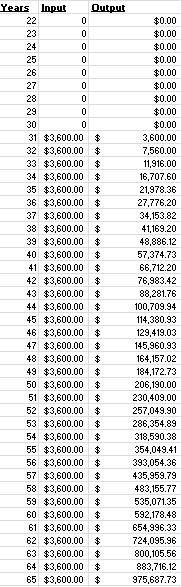
The point is, start saving early because it does not make much initial money to make you a millionaire! Of course, compounding interest can also work against you if you have debt, so it's important that you pay off your debt as quick as you can. If you would like me to crunch some number for your unique situation, let me know!
Take care.
Maybe a few hundred thousand? You may think $200,000 would be a nice chunk of change that would be waiting for you at 65 after you only put in $32,400 total. Well I think you will be pleasantly surprised....... drum roll........$1.37 million! You could be a millionaire when you retire! Don't believe me? Here is the year by year breakdown of what you put in each year and your total at the end of the year:

You can see that at the beginning, say the first 10 years after you stopped saving, your investment does not grow that large. This is because compounded interest needs time to work. The sooner you start saving the better! Let me show you another example that illustrates the importance of saving as early as possible. In this example, you start saving $300 a month when you turn 31 and continue to save $300 a month every month until you retire at age 65 (a total contribution of $126,000). If you earn 10% annually, how much money do you think you would have at 65? It has to be more than $1.37 million right? Maybe $4 million? $8 million. Let your imagination go......drum roll......$975,000. That's right. Less than a million dollars. Less than the first example! Here is proof:

The point is, start saving early because it does not make much initial money to make you a millionaire! Of course, compounding interest can also work against you if you have debt, so it's important that you pay off your debt as quick as you can. If you would like me to crunch some number for your unique situation, let me know!
Take care.
Sunday, October 23, 2011
America: Home of the Financially Illiterate
It's kind of amazing to me how financially illiterate our country is. I'm not talking on a national level, although our government needs some help, but on an individual level. I am just now, in my senior year of college, taking my first wealth management class (I am not counting that joke of a class consumer ed that we had to take in high school). This got me thinking, why so late? We all need to learn this stuff sooner and be reminded of it more often. The average score on a financial literacy test for high school students was 48%. That is an F ladies and gentlemen. The average score on that same test for a college students? 62%. Better but still awful. My question is, why aren't kids being taught wealth management sooner? Money management is basic math. It's pretty simple, yet people don't know it.
Let me give you a test:
1. Suppose you had $100 in a savings account and the interest rate was two percent per year. After 5 years, how much do you think you would have in the account if you left the money to grow?
a. More than $102
b. Exactly $102
c. Less than $102
d. I don't know
2. Imagine the interest rate on your savings account was one percent per year and inflation was two percent per year. After one year, would you be able to buy more than, exactly the same as, or less than today with money in this account?
a. More than today
b. Exactly the same as today
c. Less than today
d. I don't know
Got your answers? I'll give you another minute to really think those over. I will start by telling you that only 56% of Americans would get those two questions correct. Ready to see if you are in that 56%? The answer to question #1 is "a" and the answer to question #2 is "c." If you did not get both of those right, you are not alone. If you did, well then, it's only two basic questions so don't get cocky. One last question:
3. Do you think the following question is true or false: "Buying a single company stock usually provides a safer return than a stock mutual fund."
a. True
b. False
c. I don't know
This one should be a bit easier. The answer is "b." Now if you answered all three of those questions correctly, you are part of 34% of Americans who may be somewhat financially literate. That means 66% of Americans don't know this stuff. Stephen J. Dubner in Freakonomics makes a wise point. He says:
"I am all in favor of a well-rounded education, but seriously: what good is it if high-school students learn Flaubert, biology, and trigonometry if they don't learn how to take care of their money? One bright side to the increasingly dark economic news these days is that more and more people will learn (albeit the hard way) Rule #1: Do not buy what you cannot afford."
In middle school and high school we learn about biology, chemistry, physics, algebra, geometry, history, english, and maybe a foreign language, but where is the class that teaches financial literacy? Sure some schools have economics, maybe a basic accounting class, and a consumer education class, but I would bet that those classes aren't teaching students what they really need to know and what they will need to apply when they get older. Heck, I'm a finance major, and I'm learning about essential aspects of financial literacy as a senior in college! Two things are wrong with that. One, I am a senior in college. Why wasn't I taught this earlier? It's not like I haven't been earning and spending money for the past 6+ years. Aspects of financial literacy should be introduced in elementary school and be a mandatory subject to take every year until you graduate high school. Second, I am a finance major, and I am learning this stuff. Not that I don't need to know this stuff, because I definitely do, but what about all the other non-finance majors? Do they not get to learn the stuff I'm learning? It's kind of like "the rich get richer" because most finance students already know a decent amount about money and how it works, so they don't need to know these things as much as non-finance majors and yet, they are the students who get taught how to manage money. My point is, everyone needs to be financially literate, not just finance and accounting majors. Everyone. Everyone will most likely earn money some point in their life and everyone needs to know how to handle it! I'm dumbfounded that this stuff isn't taught to more students.
Dubner goes on to list 5 pieces of financial literacy that he believes should be taught in schools. They are:
1. Basics of how markets work. Things like: it is the law of demand and supply that determines prices in competitive markets, and the interest rate is the price of money.
2. Time value of money and the working of interest compounding: Because so many payments in finance happen at different points in time, one needs to know how to compare payments. Discounting is at the basis of asset pricing. What is the price of bonds? It is the present value of its payments. Interest compounding is a fundamental concept and it requires a little bit of math. It is critically important to understand interest compounding to be able to fully appreciate the importance of starting to save young and how to borrow and handle debt.
3. The concept of risk and the working of risk diversification and insurance: A lot of the decisions about saving and investing have to do with how to handle risk.
4. Basic accounting: To know the net values one needs to subtract assets and liabilities, and that it makes a big difference between whether we choose market prices versus book prices.
5. Rights and responsibilities of consumers and institutions. People need to know there is a Federal Deposit Insurance Corporation, bank deposits are safe (up to $100,000), and there is no need to line up to withdraw deposits; they should know who does and does not have fiduciary duties and what it means to use a financial advisor (you cannot sue them if the stock market plummets).
Now how many of you can tell me you know this stuff? Very few I imagine, and that's a problem.
So the point of this blog is to share information. Share information that most would consider an afterthought. But also I want to start a conversation. I want to know what you think. I will continue to post interesting and debatable topics in the coming weeks and months, and I would love to hear your thoughts and feedback! Leave a comment or feel free to send me an email at dan.boduch@gmail.com.
Take Care.
Subscribe to:
Posts (Atom)